The Website I Forgot Died — But Another One Survived 19 Years
From an automated knowledge machine to a digital café, why the plainest forum on the web remains the last room with actual humans
SELF
The Website I Forgot Died — But Another One Survived 19 Years
On August 26, I published an essay on the slow death of Stack Overflow.

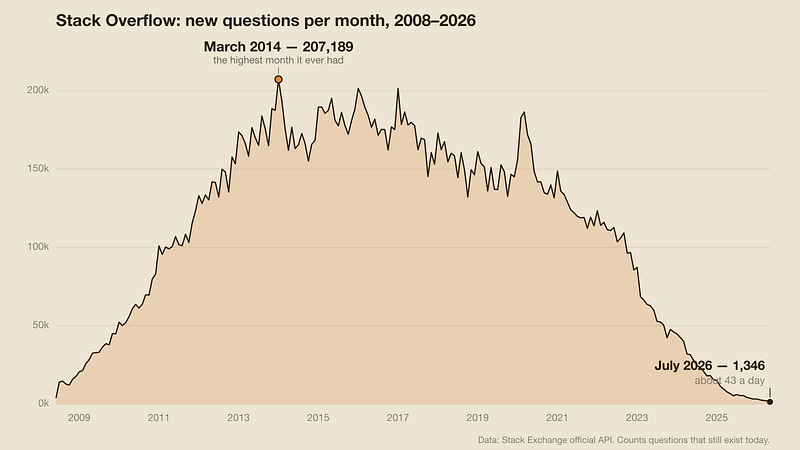
After that piece went live, readers sent in dozens of messages echoing the same anxiety. If Stack Overflow, with its 24.14 million curated questions, could be emptied out by large language models in under two years, did that mean developer communities were finished?
The answer is no. One year before Stack Overflow was founded — in February 2007 — another developer website went live without fanfare.
That site is now nineteen years old.
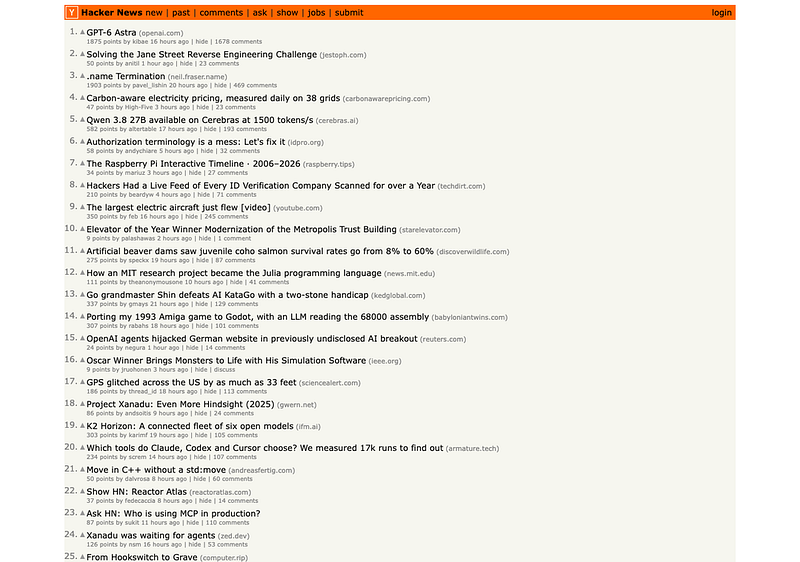
Its front page looks almost identical to the day it launched. Single-column plain text, structured like the output of ls -l in a terminal. No images. No display ads. No upvote micro-animations. No personalized recommendation engine.
Any modern product manager looking at it today would declare it long overdue for a museum exhibit.
Yet its monthly traffic ranks it among the top 5,000 websites globally. More remarkably, over 66% of its desktop visitors type the URL straight into their address bars. It spends nothing on user acquisition, and it never depended on search engines for survival.
The site is Hacker News.
Its continued existence stands as an open rebuke to every growth hack invented over the past fifteen years.
A Knowledge Sorter Meets a Digital Café
In 2008, Joel Spolsky and Jeff Atwood founded Stack Overflow with a clear mission: build an encyclopedic, structured repository of developer knowledge.
Every technical problem had to yield exactly one canonical answer. No chitchat allowed. No duplicate questions tolerated. They treated every inquiry like a Wikipedia entry.
In February 2007, Paul Graham launched Startup News inside Y Combinator, renaming it Hacker News six months later. His motive was modest. It was an experimental side project designed to give software hackers an unpretentious place to speak freely.
Two platforms founded in the same era took radically divergent paths.
Stack Overflow engineered itself into a precision knowledge-sorting machine. To maximize efficiency, it stripped away pleasantries and prioritized standardized answers above all else.
That pursuit made sense at the time, but it harbored an inherent vulnerability: any highly structured, standardized repository of technical facts becomes the ideal training diet for large language models.
Once neural networks ingested those 24 million questions and began serving answers in milliseconds, the sorting machine lost its reason to exist.
Hacker News was never a reference tool. It was designed as a digital café.
People do not walk into a café to consult a dictionary; they go to hear what their peers are thinking. On Hacker News, discussions rarely dwell on why an argument threw an error. Instead, engineers debate architectural trade-offs, the hidden costs of distributed systems, or the lessons of abandoning microservices to return to a monolith.
AI can produce correct code in seconds, but it cannot synthesize human taste, engineering judgment, or honest debate.
Designing Against the Modern Playbook
Over the past decade, consumer internet platforms perfected a relentless growth playbook: algorithmic feeds, infinite scroll, visual stimulation, and dopamine-driven loops.
Hacker News rejected every single one of those conventions.
First, it banned images.
Neither story submissions nor comments allow embedded graphics. That single design constraint filters out reaction GIFs, infographic spam, and visual noise. If you want to contribute, you must write out your reasoning in prose. Prose demands deliberate thought; images often encourage passive scrolling.
Second, it created asymmetric voting mechanics.
Most modern discussion boards maintain symmetric upvotes and downvotes. Hacker News handles them differently: story submissions can only be upvoted, never downvoted. Comments can only receive downvotes after a member accumulates 501 karma points.
This asymmetry nudges irritation into silence rather than open hostility. If a post fails to interest you, you scroll past it, rather than clicking a downvote arrow to vent frustration.
Third, it delivers a single, unfragmented front page.
Modern platforms push algorithmic personalization until every user inhabits an isolated echo chamber. Hacker News acts like a morning newspaper. Whether you are Sam Altman or an undergraduate writing your first C program, the top thirty links on the front page are identical.
Everyone views the same page, preserving a shared context essential for public discourse. Recommendation engines fracture audiences; Hacker News gathers them in one room.
Crucially, its core architecture remained untouched for nineteen years.
It never needed quarterly product updates to appease venture capitalists, nor did it rewrite its interface every three years to chase frontend fads. Lacking a growth mandate, it retained the rarest virtue in commercial software: genuine restraint.
An Algorithm Named Dang
The slow collapse of Stack Overflow did not begin with ChatGPT. It started around 2014, when community governance began to decay.
Automated duplicate-detection scripts slammed questions shut, alienating newcomers with abrupt closures. Later, corporate leadership issued directives barring volunteer moderators from flagging synthetic AI content, triggering a widespread strike in 2023. Automated enforcement drove the people away.
Hacker News enforces community guidelines that read like legal statutes: avoid sensationalist headlines, never solicit votes, refute arguments rather than attacking individuals, and never ask a commenter whether they read the article.
Yet the enforcer of these strict standards is not an automated bot. It is an actual person.
From 2007 through 2014, Paul Graham moderated the site personally. While running Y Combinator, he spent hours pruning clickbait, adjusting rank penalties, and banning disruptive actors.
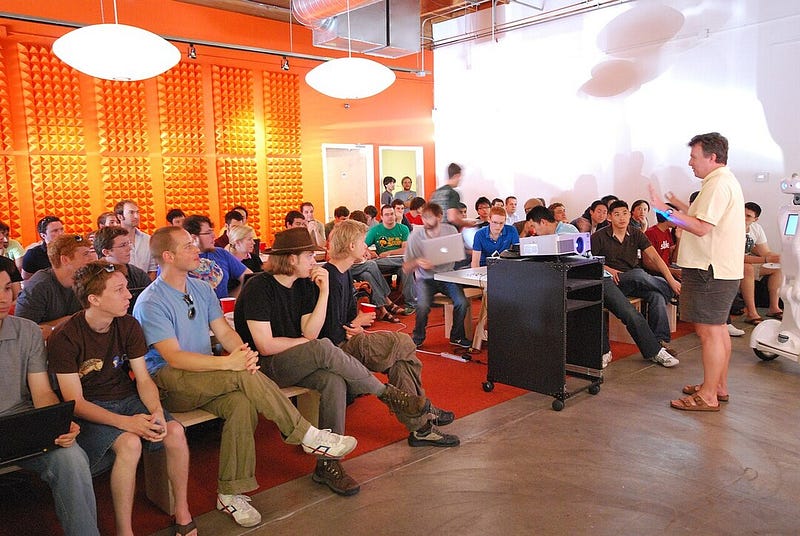
In March 2014, Graham stepped down as YC president and passed stewardship of Hacker News to Daniel Gackle, known across the site as dang.
Gackle remains on duty today.
He does not operate like an automated filter. When arguments turn caustic, he steps into the comment thread with calm, articulate explanations. He unpacks why a comment broke site etiquette and nudges participants back toward constructive analysis. When users ask why their submission failed to reach the front page, he answers them directly.
While mainstream networks outsource moderation to automated filters and third-party content farms, Hacker News’s primary moat is a dedicated human moderator engaged in daily, civil conversation.
Hacker News has an algorithm. Its algorithm is simply a patient, thoughtful human being.
Item 8863 and the Currency of Trust
On April 5, 2007, Drew Houston submitted a modest link to Hacker News:
My YC app: Dropbox — Throw away your USB drive
The database assigned it the ID item=8863.
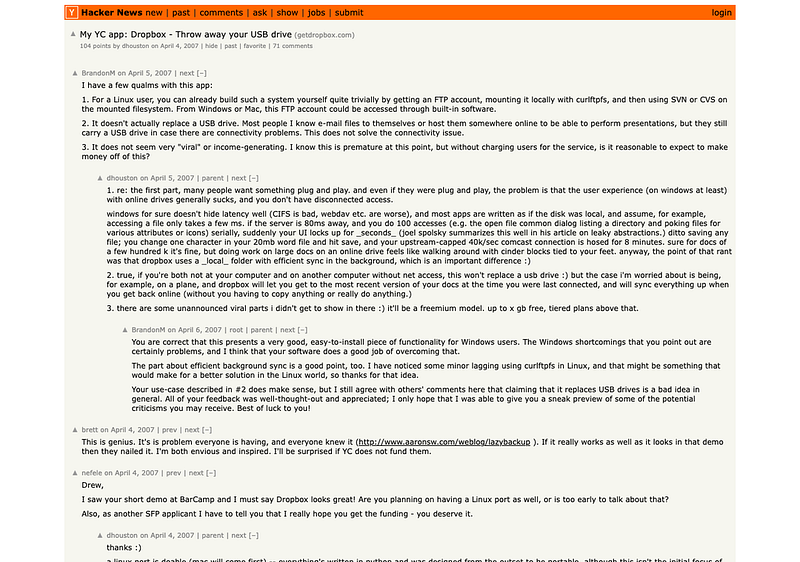
Nineteen years later, that conversation remains live on the site. Readers criticized the architecture, questioned the market demand, and offered precise technical recommendations. Those skeptical early commenters became Dropbox’s earliest evangelists.
Later, Patrick Collison unveiled Stripe on the site, while Brian Chesky brought early versions of Airbnb to the forum for peer scrutiny.
Top engineers continue returning to Hacker News because they know the space is free from PR bot farms, covert algorithmic boosts, and paid influencer campaigns.
In an age when online attention is abundant and cheap, trust has become the rarest asset on the internet. Hacker News does not trade in attention; it preserves peer trust.
Real People in an Emptying Web
Much of the modern web now resembles the Dead Internet Theory.
Social media feeds are flooded with synthetic posts generated by automated prompts, while technical blogs are swollen with AI-generated filler. Even Stack Overflow, once the premier temple of developer knowledge, sits largely quiet under automated reposts.
In my last essay, I noted AI returns answers faster and with impressive accuracy. The only trouble is that nobody sits behind those answers anymore.
Whenever that synthetic expanse feels hollow, visit news.ycombinator.com.
The orange top bar remains. The monospace links still scroll down the screen. Dang is still calming heated debates, and engineers from around the world still argue late into the night over compiler passes and distributed systems.
The answers to our programming syntax now belong to artificial intelligence.
Human curiosity still belongs to Hacker News.
References
- Hacker News FAQ: https://news.ycombinator.com/newsfaq.html
- Hacker News Guidelines: https://news.ycombinator.com/newsguidelines.html
- Dropbox Launch Post (item=8863): https://news.ycombinator.com/item?id=8863
- TechCrunch: Paul Graham Hands Over Reins at Hacker News (March 2014): https://techcrunch.com/2014/03/29/after-stepping-aside-from-y-combinator-paul-graham-hands-over-the-reins-at-hacker-news/