I Forgot About the Website I Used to Live On
From 3,744 questions a month to 207,189, and now 43 a day

CODING
I Forgot About the Website I Used to Live On
How long has it been since you last opened Stack Overflow? For me, it was about two years ago.
Back then, I answered Go and database questions there. I built up some reputation and had a few answers voted up. Not a big name, but not someone who only read either.
Then I stopped. There was no moment when I decided to. One day I just noticed I hadn’t opened it in a long time.
The answers were locked behind a paywall
Before 2008, when a programmer hit a problem and went looking on Google, the top result was often a site called Experts Exchange. The question was right there. The answer cost twenty dollars a month to read. Other programmers wrote those answers and got nothing for them. The site kept the money.
This annoyed Jeff Atwood. He was writing a blog called Coding Horror at the time, started in 2004, and by 2007 around a hundred thousand people read it daily. In early 2008, he reached out to Joel Spolsky, a former Microsoft Excel program manager who wrote Joel on Software, the other big name in that circle.
The two of them decided to build their own. Free, and the answers stay public forever.
They had the idea, but what to call it? They didn’t decide themselves. They put it to a vote among Coding Horror readers. Stack Overflow won. That August, it opened in closed beta and took 3,744 questions in its first month. It opened to the public on September 15.
Their technology choice looked strange at the time. In 2008, the startup world ran on LAMP and Rails; the two of them picked C#, ASP.NET, and SQL Server, the whole Microsoft stack. The reason was simple: use what you know best.
Technical forums were everywhere back then, and they all had the same problem: everything stacked up by timestamp. You’d find a thread, the question sat at the top, and underneath were dozens of replies saying “bump,” “same here,” or “watching this,” while the answer that actually worked might be on page five.
Stack Overflow didn’t sort by time. It sorted by votes: the answer that made the most sense could get pushed to the top. Categories became tags. The pages were stripped clean, so a Google search dropped you straight onto the answer.
They treated every question the way you’d treat a Wikipedia entry — something that would still be useful to whoever found it ten years later.
That idea caused problems later. But that was ten years off.
Six years, from twenty thousand to two hundred thousand
Stack Exchange has a public API. One command tells you how many new questions a given month got:
curl -s "https://api.stackexchange.com/2.3/questions?site=stackoverflow&fromdate=1420070400&todate=1422748800&filter=total"
# {"total": 165742}
I ran it for all 216 months from August 2008 to July 2026.
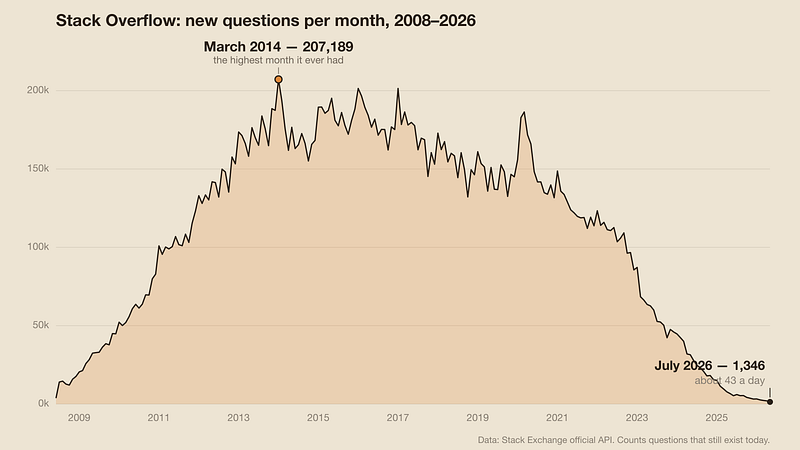
Here are the March numbers through the climb: 20,477 in 2009. 52,224 in 2010. Past a hundred thousand in 2011. 132,946 in 2012. 173,606 in 2013.
March 2014: 207,189.
That was the peak. Over eighteen years, the site accumulated 24.14 million questions that are still up. They solved an enormous number of problems for me when I was starting. AI has replaced them now.
It started turning away the people asking
The reason it faded was already in place by 2014.
That year Stack Overflow got more efficient at moderation: duplicates and “low quality” questions were cleared out faster. The logic was sound enough. If you’re building something that works like a Wikipedia entry, still usable ten years on, then the same question shouldn’t have a second answer, and the bar for a question can’t be too low.
But the bar for asking went up with it. A newcomer would post a question and have it closed within minutes, with a note saying “this question is a duplicate” and a link to a thread from eight years earlier whose context might have nothing to do with what they meant to ask.
In April 2018, Stack Overflow said this out loud itself. Jay Hanlon, then VP of culture and experience, published a post titled “Stack Overflow isn’t very welcoming. It’s time for that to change.”:
“Too many people experience Stack Overflow as a hostile or elitist place, especially newer coders, women, people of color, and others in marginalized groups”
In my data, the sustained decline began in March 2018, down 14.2% year over year. They saw the trend, and they named it. They couldn’t stop it.
Then the moderators left too
In September 2019, longtime moderator Monica Cellio questioned a code of conduct that had not been published yet, and had her moderator status revoked across the network. Twenty of the six hundred-odd volunteer moderators protested publicly. Three months later, the company settled with her.
June 2023 was more direct: the moderators went on strike. The company had privately told them on May 29 to stop flagging AI-generated content. The moderators said the policy made it impossible to do their job — and that it had been handed down without anyone being consulted.
This isn’t only how I read it. In December 2025, a paper analyzing that strike appeared at ACM CSCW, titled “AI Didn’t Start the Fire.” The authors went through 2,070 messages on Meta Stack Exchange and interviewed 14 people. Their conclusion was long-term governance decay. Decisions shifted from “we discuss this” to “we’re informing you,” and that wore down the community’s loyalty a little at a time. AI wasn’t the cause of the strike. It was the last thing to set it off.
One interviewee put it plainly:
“We were just fed up with it”
And then I stopped going too

When I hit a problem now, my first move is to ask an AI. The answer comes faster than paging through a thread, and nobody tells me my question is a duplicate.
One thing is different, though.
Under those old answers, someone would often add a line: if you’re on a different version, watch out for this. Whoever wrote it didn’t know me, and I never thanked them. They’d probably just been stuck in the same place one night, worked it out, and written it down on their way past.
24.14 million questions is a few million nights like that, added up.
The answers I get from AI now are faster and more accurate. There’s just nobody behind them.
I went and looked again while writing this. The front page is there, the questions are there, the search box is there. Almost nobody is asking new ones.
In July 2026, the site took 1,346 new questions. That’s 43 a day. Little by little, we forgot about the site that fixed an enormous number of our bugs.
References
- Stack Exchange API: https://api.stackexchange.com/docs/questions
- Jay Hanlon, Stack Overflow isn’t very welcoming. It’s time for that to change. (April 2018)
- Wu, Ajmani, TeBlunthuis, Li, AI Didn’t Start the Fire, arXiv:2512.08884, Proc. ACM CSCW (December 2025)
- Gergely Orosz, Are reports of StackOverflow’s fall greatly exaggerated? (August 2023) / Stack overflow is almost dead (January 2025)