The Demo God That Couldn't Sell Robots
How Boston Dynamics lost the physical revolution it spent thirty years inventing

How Boston Dynamics lost the physical revolution it spent thirty years inventing
Under the blinding studio lights of China's annual Spring Festival Gala, dozens of bright-red robotic dogs move in near-flawless synchrony. They bow, roll over, and tap their composite paws in time with the music.

Dozens of quadruped robots perform in synchrony on the 2021 CCTV Spring Festival Gala stage. Machines that once lived only in DARPA laboratories have become staples of mainstream entertainment. Photo: CCTV Spring Festival Gala.
Across the country, on the rubber tracks of the World Humanoid Robot Games, two-legged machines sprint toward hurdles. When a runner stumbles and clatters onto the track, it levers itself back onto its feet within seconds, prompting polite applause from a crowd that already treats running machines as normal.

Two bipedal robots sprint shoulder-to-shoulder during the 100-meter dash at the 2nd World Humanoid Robot Games. Photo: World Humanoid Robot Games Live Broadcast.
Today, audiences take backflips and sprints for granted.
Yet beneath the noise of mass-market robotics, a strange silence hangs over the pioneer.
A decade ago, the undisputed ruler of this future was Boston Dynamics.
Back then, every viral clip that terrified and mesmerized humanity came from a single nondescript brick warehouse in Waltham, Massachusetts. BigDog was recovering from an icy kick with horrifying animal agility, WildCat tearing across frozen fields, and Atlas executing backflips with superhuman precision. Each upload racked up tens of millions of views. Elon Musk warned, half-jokingly, that silicon-based life was about to surpass humans.
Why has the pioneer that stood atop the global pedestal all but vanished from today's industrial manufacturing floors and commercial delivery sheets?
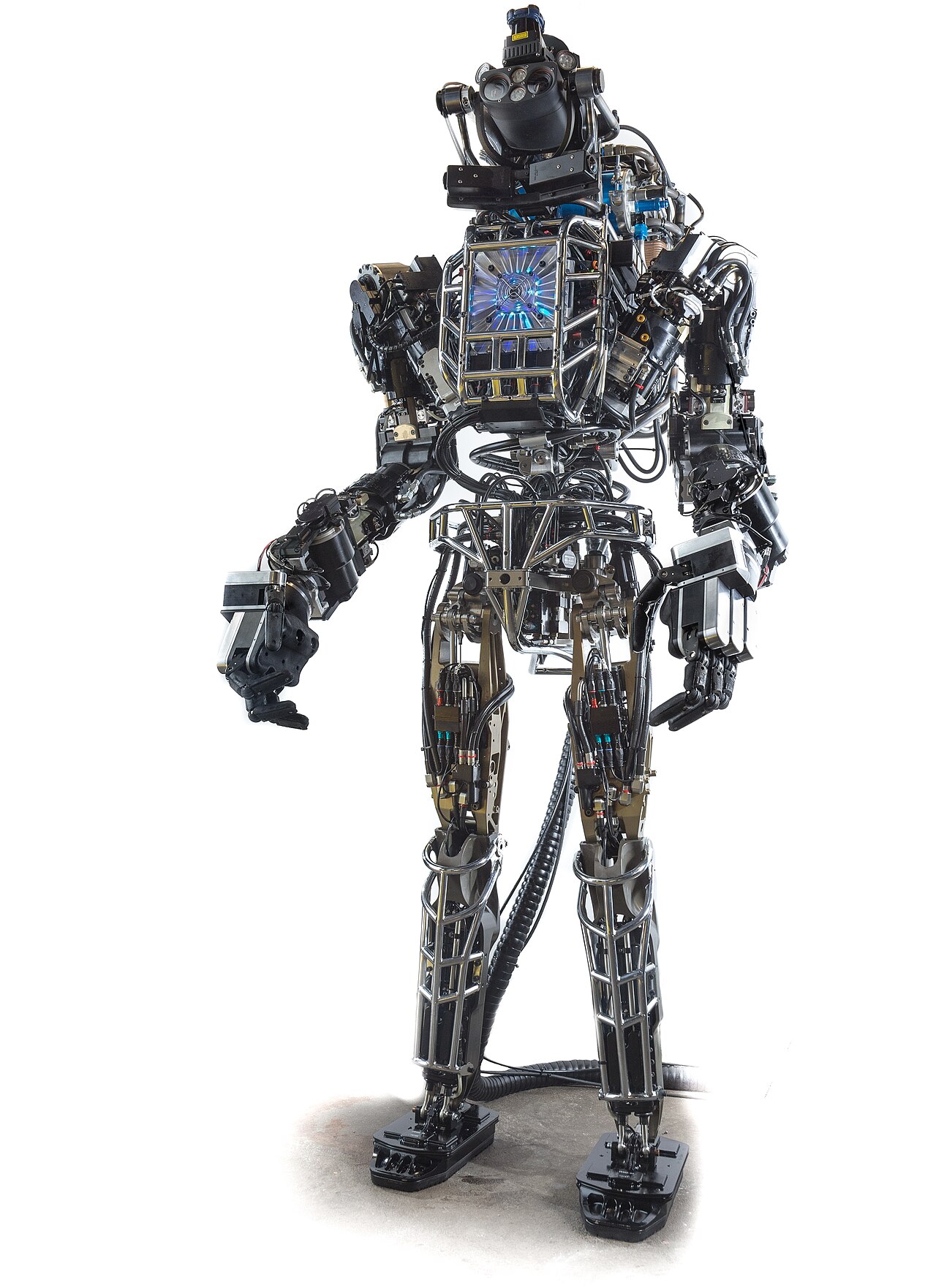
The hydraulic Atlas unveiled in 2013. Weighing 330 pounds and threaded with 3,000-psi lines, it marked the pinnacle of high-pressure fluid engineering. Photo: DARPA / Wikimedia Commons (Public Domain)
A Theater Built for the Viewfinder
To understand what happened to Boston Dynamics, you have to look at how it began.
The company was never structured to manufacture industrial goods. From day one, it was designed as a physical theater engineered to stun the camera lens.
In the 1980s, Marc Raibert at the MIT Leg Laboratory arrived at a counterintuitive physical insight: running is not the maintenance of static balance, but controlled falling.
A running body spends most of its time airborne or tipped precariously beyond its support polygon. You do not stay upright by standing still; you stay upright because dynamic feedforward kicks the opposite leg forward at the exact instant of the drop.
In 1992, Raibert spun Boston Dynamics out of MIT. For the next twenty years, the company took virtually no outside venture capital.
It was nurtured instead by tens of millions of dollars in federal research grants, supplied continuously by DARPA.
Inside that military greenhouse, Raibert developed an obsession with the lens. As he would later reflect, "All my life, I've been focused on how this thing looks through the viewfinder. I was never a commercial guy."
That institutional DNA produced the greatest viral myth of the YouTube era.
A sixty-second parkour clip might require a robot to crash and shatter its limbs 109 times. Raibert did not care, provided that the 110th take captured that flawless leap before the cameras. By 2010, the studio proudly declared that it held the most-viewed science and technology video in YouTube history.
Boston Dynamics' viral 60-second routine: "Atlas | Partners in Parkour" (YouTube: tF4DML7FIWk). Behind the seamless leaps lay months of trial and error and catastrophic mechanical failures in the test bay. Photo: Boston Dynamics.
Yet beneath the viral aura lay a brutal reality: in twenty-eight years of existence, Boston Dynamics had never sold a single commercial product to the open market.
It produced astonishing demonstrations, not inventory.

Marines field-testing the Legged Squad Support System (LS3) in Kahuku, Hawaii, during the 2014 RIMPAC exercise. Photo: Lance Cpl. Matthew Bragg / U.S. Department of Defense DVIDS (Public Domain)
Military Rejection and the Roar of the Mower
The company's first collision with reality arrived in the summer of 2014 in Hawaii.
During the Rim of the Pacific (RIMPAC) military exercise, Lance Cpl. Brandon Dieckmann of the 3rd Marine Regiment was chosen to operate the Legged Squad Support System—a massive, gas-powered quadruped the troops nicknamed Cujo.
On video, LS3 trotted effortlessly across jagged lava rocks with 400 pounds of gear, resembling a tireless mechanical pack mule from science fiction.
Yet once stripped of cinematic editing, the physical battlefield issued an immediate penalty.
To power 400 pounds of payload and high-pressure hydraulic servos, the machine carried a four-stroke internal combustion engine. When it fired up in the Hawaiian brush, it sounded like multiple commercial lawnmowers screaming simultaneously.
Frontline Marines delivered an unvarnished verdict: "It was too loud. It would give away our position hundreds of meters away. All the enemy had to do was follow the noise and drop mortars, and our entire squad would be wiped out."
Worse, LS3's hydraulic lines ran at 3,000 pounds per square inch—roughly 200 atmospheres. When dynamic O-rings degraded or hoses ruptured in the mud, ordinary riflemen had no way to service them. A multimillion-dollar iron beast instantly became a useless monument.
In late 2015, the U.S. military made its decision: the LS3 and its lightweight variants were formally mothballed into storage, and future procurement was halted.
The Pentagon had grown tired of funding exotic toys that could not survive operational combat. Boston Dynamics' thickest umbilical cord was severed.
The Corporate Hand-Off
Cut off from long-term military underwriting, Boston Dynamics had to face private capital, embarking on a painful corporate relay race.
The first buyer was Google, which acquired the company in late 2013 under Android founder Andy Rubin.
Yet Google's patience evaporated almost immediately. A leaked internal memo from a late-2015 leadership meeting revealed the tension: executive Jonathan Rosenberg bluntly stated, "We cannot spend 30-plus percent of our resources on things that take ten years."
Public perception added further friction. When Boston Dynamics published footage of engineers shoving robots with hockey sticks to prove stability, viewers reacted not with fascination, but with dread over relentless mechanical terminators. Google's communications team explicitly demanded distance from the clips in internal emails, and in 2017, Google unloaded the business to SoftBank.
Masayoshi Son attempted to force commercialization. In June 2020, Boston Dynamics finally released its first commercial product in twenty-eight years: Spot, the yellow quadruped robot.
Yet the base price was $74,500—the cost of a luxury sedan.
That price tag made mass industrial adoption impossible. Beyond a handful of utility companies buying units for remote substation inspection and university labs acquiring them as teaching aids, the wider market remained silent. Subsequent CEO Robert Playter admitted: "Spot was a technology looking for an application."
In late 2020, SoftBank passed the business to its third owner, South Korea's Hyundai Motor Group, at a $1.1 billion valuation.
Hyundai initially planned to deploy humanoid robots along the assembly lines of its automotive manufacturing plants.
Yet public audit filings with South Korea's Financial Supervisory Service (DART) shattered any remaining romance: the more robots the company sold, the more money it lost.
Between 2021 and 2025, Boston Dynamics' annual revenue crept from $58.3 million to $106 million. Over that same window, net losses surged from $172 million to $372 million.
Across five years under Hyundai, Boston Dynamics recorded $380 million in cumulative revenue against $1.32 billion in cumulative net losses.
For every single dollar of revenue it took in, it lost $3.50 in net cash.
By mid-2025, liabilities overwhelmed assets, plunging the firm into total capital erosion, saved from insolvency only through emergency cash injections from Hyundai. In early 2026, long-serving CEO Robert Playter stepped down. That July, SoftBank exercised its put option to exit entirely.
A legendary pioneer had been backed into a financial corner.
Mechanical Feat and the Mass-Production Wave
The deeper driver behind Boston Dynamics' swamp was a generational shift in engineering and manufacturing paradigms.
On hardware, Boston Dynamics pushed high-pressure hydraulics to the limits of physical possibility. It 3D-printed titanium limbs with hollowed-out fluid conduits, developing proprietary five-kilogram power packs capable of bursting five kilowatts of power.
The explosive force was astonishing, but from an industrial manufacturing standpoint, it was a liability.
A valve-regulated hydraulic pump must maintain 3,000 psi of pressure continuously. Most input energy degrades immediately into scalding waste heat, and dynamic seals inevitably leak fluid under high-frequency cycling. On an automated assembly floor or inside a domestic living room, spraying high-pressure hydraulic fluid is an unacceptable hazard.
Meanwhile, Asian manufacturing chose an entirely different path.
Relying on mature supply chains built for electric vehicles and consumer electronics, Chinese suppliers industrialized high-torque quasi-direct drive (QDD) brushless motors. Using large-diameter, thin-ring torque motors, they eliminated oil leaks and combustion noise while driving quadruped manufacturing costs down from $75,000 to a few thousand dollars.
On software control, the ground shifted just as decisively.
Boston Dynamics' historical moat had been handcrafted differential equations and whole-body Model Predictive Control (MPC). The mathematics were exquisite, but notoriously brittle—if an unexpected pebble shifted five centimeters on the ground, the entire kinematic chain could unravel.
Today, massively parallel physics simulators running on GPU clusters, such as Isaac Gym and MuJoCo, have enabled an end-to-end Reinforcement Learning (RL) revolution.
Tens of thousands of virtual robots fall, recover, and adapt across billions of simulated interactions, generating robust neural network gaits end-to-end. Disturbance-rejection behaviors that once required elite mathematicians months of tuning now converge within days across a few graphics cards.
In April 2024, Boston Dynamics released a brief, bittersweet video:
The hydraulic Atlas was officially retired.
Its replacement was an all-electric bipedal humanoid with high-torque electric actuators, featuring 360-degree joint rotations and completely dispensing with human joint limits. The pioneer had finally surrendered its decades-long hydraulic crusade to the laws of industrial physics.
Yet by early 2026, the initial production batch of the new electric Atlas was absorbed entirely by its parent company, Hyundai, for internal factory trials, remaining unavailable on the commercial market.
From hundreds of quadruped robots tumbling across television galas to bipedal machines sprinting and self-righting at athletic games, the tide of mass industrialization moves forward.
Looking back across tech history, Boston Dynamics was never a fraud. They were the Prometheans of dynamic robotics, the ones who spent thirty solitary years proving that machines could run, vault, and somersault in the physical world.
Yet the rules of commerce remain cold and unyielding:
Stunning the world in a YouTube viewfinder and convincing customers to buy in volume remain separated by an entire industrial epoch.